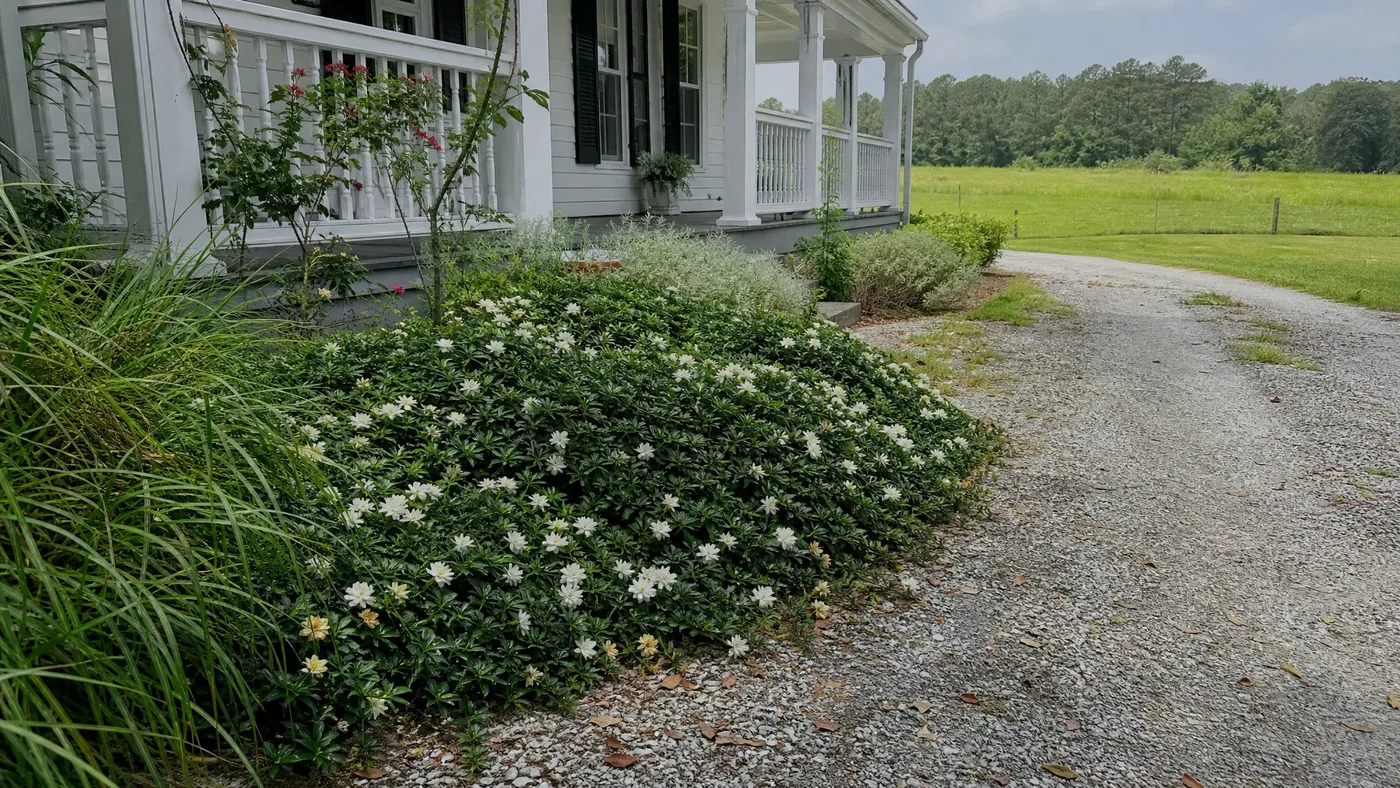
Best Dwarf Gardenia Varieties and How Radicans Compares
A tag on a gardenia says "dwarf." Before you carry it to the register, ask two things: what did the grower measure, and when? A shrub that tops out at 3 feet is dwarf next to a species plant that reaches 6–8 feet, yet it is a giant beside a plant that stays under a foot. The word has no fixed size behind it, and a young plant in a 1-gallon pot tells you nothing about year five.
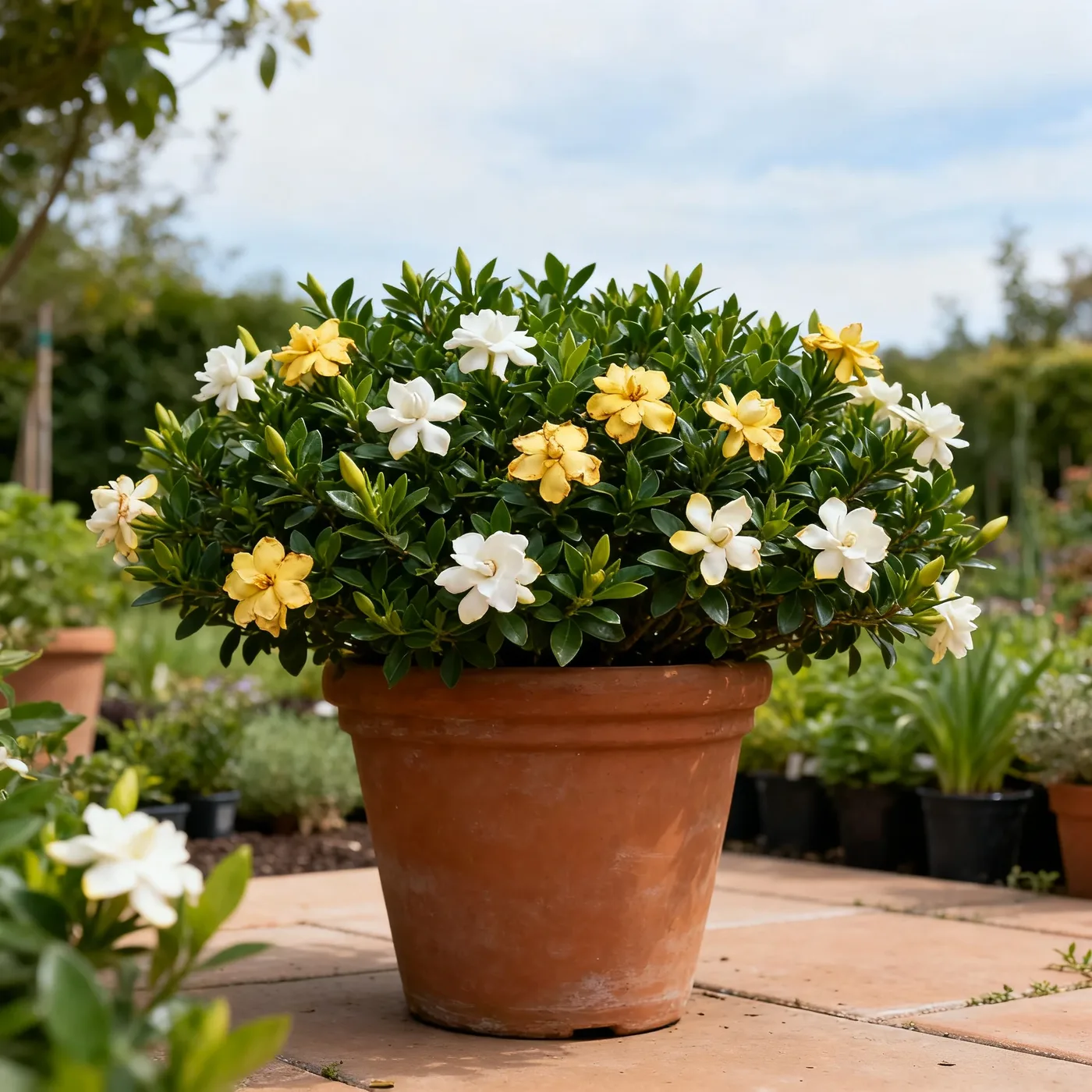
This article talks about how the compact gardenias compare on height, cold tolerance, soil, upkeep, flowers and spread, and answers the questions customers ask us most. Read on to learn which claims on a tag hold up, which ones nobody can check, and where Radicans earns the lowest spot in the bed.
Does Dwarf Gardenia Radicans Really Stay Low?
Published heights for Radicans disagree, and that gap is where misleading tags come from. Clemson lists it at only 6 to 12 inches tall with a 2 to 3 foot spread. NC State's species page gives 6 to 18 inches. The Arkansas extension puts Radicans and Kleim's Hardy both near 2.5 feet, which is a very different plant.
Part of the confusion is naming. Florida's extension notes that some nurseries and catalogs sell 'Prostrata' as 'Radicans'. If two growers sell different plants under one name, their measurements will not match either.
Reading a Height Claim Honestly
A height on a tag should come with an age and a method. Ask whether it is the plant in its pot, the plant after several years in the ground, or a figure copied from a reference sheet. A plant described as 6 to 12 inches in one source and 2.5 feet in another is being measured by people who either counted different things or grew different plants. Until the seller can say which, the number is decoration.
What the Published Numbers Show
This table lays out what the sources actually give for each compact option, and where no published figure exists.
| Cultivar | Published height | Published width |
|---|---|---|
| Radicans | 6–12 inches, about 2.5 feet (Arkansas) | 2–3 feet |
| Kleim's Hardy | 2–3 feet, with 3 feet at the upper end | 2–3 feet |
| White Gem | Under 2 feet | Not given |
| Shooting Star | No verified figure | No verified figure |
| Buttons | No verified figure | No verified figure |
Verdict. Radicans is the lowest option, and the only one where a published source says under a foot. For Shooting Star and Buttons, ask the seller for a measured height at a stated age. If they cannot give one, treat "dwarf" as a guess. Our guide to how big Radicans gets covers its growth in more detail. Veitchii is not a contender, since it grows 4 to 6 feet tall.
Hardiness Claims Worth Doubting Before You Buy
A zone range on a tag is a claim, not a measurement, and the sources for these cultivars do not agree with each other. NC State lists Radicans for zones 7b, 8a and 8b only. It is not very cold hardy, and dwarf cultivars are often more cold sensitive than the full-size ones. Florida lists Prostrata for zones 8 through 10.
Kleim's Hardy has the strongest case. Clemson says it is hardy to 10°F, and NC State lists it for zones 7a through 11b. The Arkansas extension names it, along with Shooting Star, among the most cold hardy picks for zone 6 parts of that state. Treat that as a recommendation, not a guarantee, and check with your local extension service.
Buttons has no hardiness figure in any source we trust, so we would not buy it for a cold bed on the strength of a tag. The species itself is listed for zones 7b through 11b, so a compact cultivar claiming a wider range than the species deserves extra doubt. Our comparison of Radicans and Kleim's Hardy goes deeper on the 7b edge.
Cold damage is also easy to misread on a low plant. Radicans is not frost tolerant, so browned or blackened leaves after a freeze are weather damage, not a disease to spray. Because the plant sits so close to the soil, a hard freeze can reach most of its growth at once.
Verdict. Kleim's Hardy wins on cold, with Shooting Star close behind on the Arkansas recommendation. Radicans is a choice for mild winters, and a low mat has no height to spare if a hard freeze damages the top growth.
Soil Fussiness Across the Compact Cultivars
Every source we checked asks the same thing of gardenias: acid soil with a pH below 6.0, moist but well drained. Radicans wants acid soil below 6.0, and the same goes for the genus as a whole. Missouri recommends at least 50 percent peat moss or other organic material for acid-loving plants in a container mix. None of these sources describe a compact cultivar that relaxes the rule.
Drainage is where the problems start. Root rots show up primarily in poorly drained soils, and a plant that stays under a foot tall gives you little warning before the roots are in trouble. Yellowing leaves are the usual first sign when pH drifts upward or the soil stays soggy, so test before you reach for fertilizer.
One common piece of advice is to plant gardenias in whatever amended soil the bed already has. We disagree. Mix in organic matter and test the pH first, because lime-rich fill or a concrete foundation nearby can push a bed out of range. Our guide to the best soil and pH for Radicans walks through testing and adjusting.
Pots change little. Extension sources for potted gardenias still ask for an acidic, evenly moist mix, so a compact cultivar in a container needs the same peat-rich blend, not a general potting soil.
Verdict. It is a tie. Kleim's Hardy, Shooting Star, Buttons and Radicans all demand acid, well-drained soil, and no source ranks one as more forgiving. Pick on the other criteria and prepare the soil the same way for any of them.
Dwarf Gardenia Radicans Upkeep Against Taller Rivals
Upkeep differences come down to size. Prune after flowering in summer to remove straggly branches and faded flowers. A 3-foot Kleim's Hardy needs that cut to hold its size. A mat under a foot tall mostly needs tidying, which is why we call Radicans the easiest of the group to keep.
Pests do not follow size. Whitefly is the most commonly occurring problem on gardenias, and Florida lists whitefly, scale and aphids for the trailing form. Whiteflies leave sugary honeydew that feeds sooty mold, so treat the whitefly, not the black film.
Here is the yearly routine we tell customers to expect for any compact gardenia:
- Prune right after the main bloom in summer, taking out straggly shoots and spent flowers. Our pruning timing and technique guide shows where to cut.
- Keep the soil evenly moist but never soggy, since both extremes cause leaf drop.
- Feed lightly. Florida describes the trailing form as preferring soil of medium fertility, so heavy feeding is wasted.
- Check leaf undersides for whitefly every few weeks through the warm months.
Verdict. Radicans wins on upkeep because there is so little structure to manage. Kleim's Hardy asks for a yearly size cut, and anything taller than that asks for more.
Bloom Size and Scent Under Scrutiny
The most repeated claim in nursery copy is that a certain compact gardenia has bigger blooms or a stronger scent. We could not find a cultivar-level comparison to back it. The numbers that do exist describe the species: its waxy flowers are 2–3 inches across, white to cream, aging to yellow, and Virginia Tech says open blooms reach up to 4 inches across.
What does differ by cultivar is flower form. The Arkansas extension lists Radicans among the double-flowered cultivars, while Clemson describes Kleim's Hardy with single flowers in summer. A double bloom looks fuller on a low plant, and a single one looks cleaner but lighter.
One of the most common questions we get is whether a smaller plant means a weaker scent. The sources call the species very fragrant and say nothing to suggest a compact cultivar loses that. Fewer flowers on a smaller plant can mean less scent in the air, though, so a 10-inch mat will not perfume a patio the way a 3-foot shrub can.
Bloom timing is similar across them. Flowers open from May through June and continue sporadically through summer. Our guide on how fragrant Radicans is sets realistic expectations.
Verdict. Choose on flower form, not on size or scent claims. Pick Radicans for double blooms, Kleim's Hardy for single ones, and treat "stronger fragrance" as unproven.
How Far Dwarf Gardenia Radicans Spreads Sideways
Radicans is a trailing, mat-forming plant, and that sets it apart from the other compact gardenias. With 6 to 12 inches of height and a 2 to 3 foot spread, it grows wider than it is tall by a wide margin. The Arkansas extension makes the same point about low cultivars, saying many stay under 2 feet with a slightly wider spread.
Kleim's Hardy covers the same 2 to 3 feet of width, but it gets there as a mound 2 to 3 feet tall, so it fills the space with height and not a low carpet. Radicans grows at a medium rate, so do not expect a solid cover in one season.
Shoppers who truly need a spreader are the ones planting a slope, edging a bed under a window, or spilling plants over a low wall. A mounding cultivar leaves bare soil between plants and blocks the low view. A trailing mat knits together.
A mat also behaves differently at cleanup time. Spent flowers and fallen leaves settle into the low foliage instead of dropping to bare ground, so plan a quick hand check after the main bloom rather than a rake.
If you want a single shrub with presence, a specimen by a door or a low hedge, Radicans is the wrong plant. Pick a mounding cultivar and plan for its height.
Verdict. Radicans is the only real spreader in this group, and it is the right pick when ground coverage is the goal.
Weighing Dwarf Gardenia Radicans Against the Field
Sorted by criterion, the winners are clear. Radicans is lowest, easiest to keep and the only true mat-former. Kleim's Hardy wins on cold, with Shooting Star as the other proven choice for colder gardens. Soil is a tie, since every one wants acid, well-drained ground. Flower form decides the rest: double for Radicans, single for Kleim's Hardy.
Radicans is the right choice if your winters stay mild, your bed drains well and you want a low edge or slope cover. Choose Kleim's Hardy if you garden near the cold edge of the range. Skip any cultivar whose seller cannot say how tall it was measured or at what age. Pick the one criterion that matters most for your bed and ignore every claim on a tag that cannot be checked against it.
Dwarf Gardenia Radicans
Nursery-grown Dwarf Gardenia Radicans in sizes from 1 Gallon, shipped to your door.
From $36.97
Shop Now →Out on the farm, our Dwarf Gardenia Radicans sits in damp, acidic soil that sheds extra water, getting sun early in the day and cover once the afternoon turns hot. Growing top-quality plants is our whole business, and we keep it small and run it on land we tend ourselves. When you have settled on the right dwarf gardenia for your bed, we would love for you to look over what we have grown.