Dwarf Gardenia Radicans vs Florida and Veitchii Gardenias
At dusk in a warm Southern garden, the scent reaches you before the flowers do. It drifts across the bed from low, dark green mounds and from taller shrubs behind them, and from the path you cannot tell which plant is making it. That is where shoppers get stuck, because Radicans, Florida and Veitchii carry similar names and look nothing alike once they mature.
Plant the wrong one and you get a ground cover that towers over the bed, or a hedge that never rises above your ankles. Below, you'll find out all about how these three gardenias differ, including where each one sits in the landscape, who visits the blooms, how the petals, buds and leaves compare, and a quick way to tell them apart. One of the most common questions we get is whether they are the same plant at different ages. They are not.
Where Gardenias Live Across a Whole Landscape
Gardenias are layered-garden plants. They do best where a woodland edge softens into lawn or bed, with high shade or morning sun overhead, leaf litter underfoot and soil that stays moist but drains.
Light to partial shade is best, preferably morning sun and afternoon shade, and that one sentence explains most of where any of the three plants in this guide should go. Put them under the open canopy of tall trees, not in a baking strip beside a south-facing wall.
Soil and Moisture They All Share
Soil is the second thing the three have in common. All gardenias want acid soil, with a pH below 6.0, along with steady moisture and good drainage. That puts them in the same neighborhood as azaleas, and a bed that suits one gardenia will suit the others. Root rots show up mainly in poorly drained soil, so a heavy, soggy corner is a bad home for a tall shrub and an even worse one for a low mound.
If you are diagnosing a struggling plant, start with the soil before you blame the cultivar. Pale new leaves on a plant that otherwise looks healthy usually point to soil that has drifted away from acid, and a local extension office can test it for you.
Where Radicans Parts Ways on Cold
The species grows in zones 7b through 11b, but Radicans is hardy only in zones 7b through 8b, and it is not very cold hardy. Common advice treats every gardenia as roughly equal in winter, and for the dwarf form that is wrong.
The 6 to 18 inches of growth sit close to cold air and frosty ground, so check the details in our guide to the zones Dwarf Gardenia Radicans grows in before you plant on the cool edge of its range.
Dwarf Gardenia Radicans Fills the Ground Layer
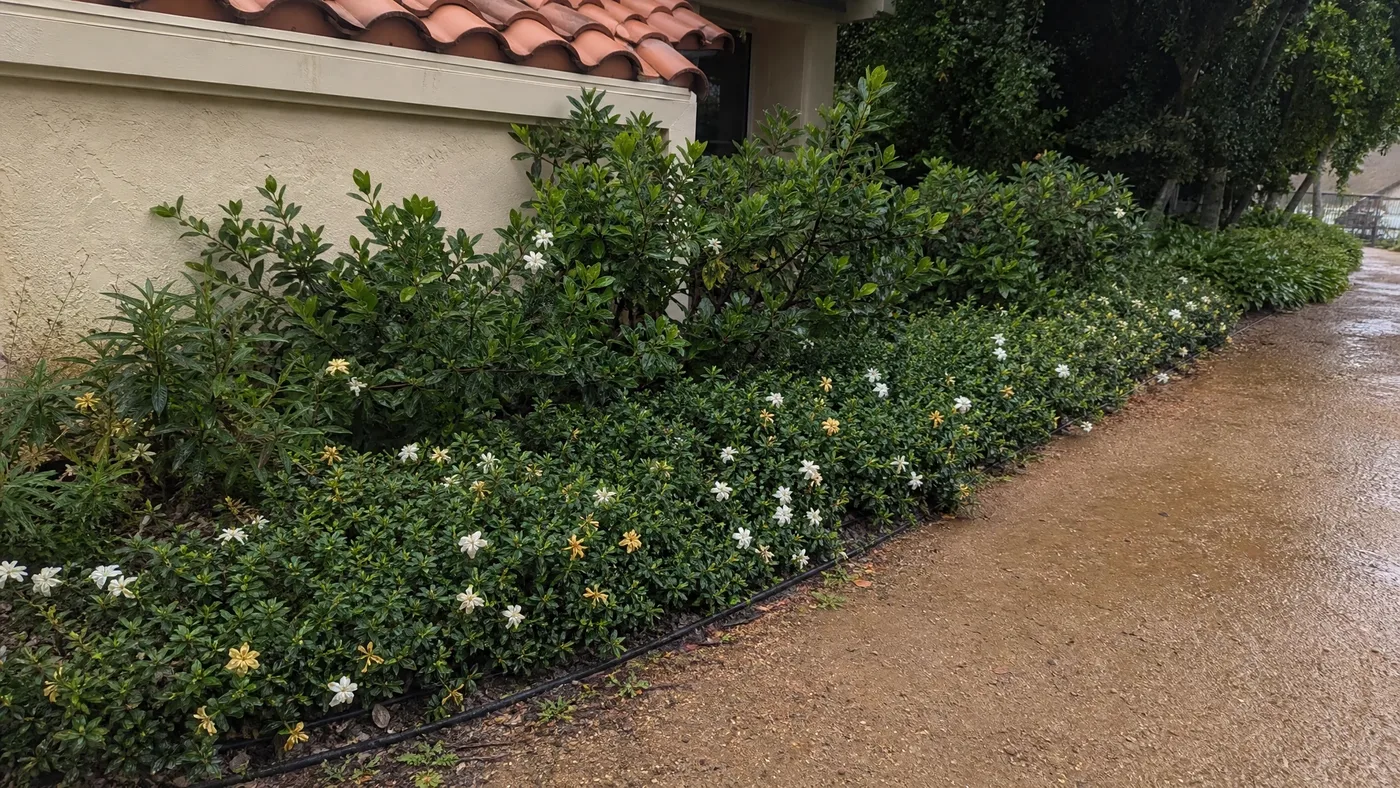
In the landscape, Dwarf Gardenia Radicans does the work of a low evergreen carpet. Clemson describes it as growing to only 6 to 12 inches tall and spreading 2 to 3 feet, while NC State gives 6 to 18 inches high and the same spread.
Arkansas extension notes that many gardenia cultivars grow no taller than 2 feet with a slightly wider spread, so a mound that stays under knee height is normal here.
That height is the whole point. Radicans belongs at the front of a border, along a walk, at the foot of a taller shrub or spilling gently over the edge of a low wall. Its small, dark green leaves form a dense, fine-textured cover that covers bare soil and shades the root zone, which is exactly what a woodland floor does. The growth rate is medium, so it fills in steadily rather than racing.
What a Mound That Low Can and Cannot Do
A ground-layer gardenia will not screen a view, block a fence line or hide a foundation. Use it for edging, for a scented skirt beneath taller plants, or for a shaded patch where you want evergreen texture all year.
Our guide on how big Dwarf Gardenia Radicans gets covers the spread in more detail, and it is worth reading before you set plants out, so the mounds have room to knit together instead of crowding the walkway.
Because it hugs the ground, Radicans also takes on the conditions at that level. Splashed soil, standing water after rain and cold air that settles low all reach it first. Good drainage matters more for a 12-inch mound than for a 5-foot shrub, which has a deeper, wider root system to buffer a bad week.
Upright Florida and Veitchii Shrubs Build the Middle
Florida and Veitchii do a different job. These are the upright, shrub-layer gardenias, standing 4 feet and up where Radicans stays under 2. Clemson calls 'Veitchii' one of the oldest cultivars, growing 4 to 6 feet tall and 3 to 4 feet wide, with double flowers and a long bloom period. For 'Florida' we tell customers to read the plant tag for mature size, because nurseries do not always describe it the same way.
This is the middle of the planting. These shrubs make an evergreen hedge, anchor a corner, screen a utility box or fill the space between canopy trees and the ground cover below. The species as a whole is a medium shrub of 4 to 8 feet tall and wide, and the upright cultivars sit at the lower end of that range.
Spacing and Pruning for Upright Plants
Plan for the width, not the nursery pot. A Veitchii that will reach 3 to 4 feet across needs that room on all sides, or it will lean toward the light and open its center. Prune just after flowering, when you can remove straggly branches and faded flowers, and not in late winter, when you would cut off the season's buds.
The reverse mistake happens too. A gardenia sold as a hedge shrub will not behave as a ground cover, and a customer who plants Veitchii along a low path edge will be cutting it back every year. Match the plant to the layer it is meant to fill and the pruning mostly takes care of itself.
Who Visits Dwarf Gardenia Radicans Blooms at Dusk
Gardenia flowers are white, waxy and strongly scented, and sources describe them as extremely fragrant. Those traits are the classic signature of flowers built for evening visitors, because pale petals show up in low light and scent carries when the air cools.
The usual night callers at flowers like this are moths, and large hawk moths in particular hover to reach nectar deep inside a funnel-shaped bloom. If you want to see them, stand in the bed at dusk and wait.
Different Heights, Different Visitors
Layering changes who arrives. On the tall shrubs, flowers sit 4 to 6 feet up, at the height where flying moths cruise along a hedge. On a Radicans mound, the inch-wide flowers sit just above the leaves, so the visitors are more likely to be small night insects and crawlers that walk across the mat.
In our rows, the low plants give off the strongest scent right where you walk, even though the best fliers work the taller shrubs. Our guide to how fragrant Dwarf Gardenia Radicans is covers what you will smell on an evening walk.
The Visitors You Don't Want
Not every insect is welcome. Whitefly is the most commonly occurring problem on gardenias, and Florida extension adds scale and aphids for the trailing form. Whiteflies leave sugary honeydew, and a black sooty mold grows on it.
Look under the leaves for the tiny white insects, because they affect the low and tall plants alike. Mammals are less of an issue, since Radicans is deer resistant, though it is not frost tolerant.
Petals, Buds and Leaf Veins Up Close
Move in close and the differences become easier to read than the heights suggest. The most reliable clue is leaf size. Radicans carries small, dark green leaves that match its small flowers, while the upright cultivars usually carry fuller-size glossy leaves on longer, woodier stems. Hold a single leaf next to a coin and the contrast is clear before you ever look at the flower.
Buds follow the same scale. Radicans buds are small, round and tucked close to the leaves, while the shrubs form larger buds at the tips of taller stems. The main flush opens from May through June, and flowers appear sporadically through summer. Veitchii is noted for its long bloom period, so expect it to keep producing after the other two have slowed.
A Hand-Lens Checklist
If you are unsure which plant you have, or you want to read its health, these four checks take a minute and no tools beyond a magnifier.
- Compare leaf size across the plant. Small leaves on a plant that is 6 to 18 inches high point to Radicans, and large leaves on a plant over 4 feet point to an upright cultivar.
- Look at the veins on new growth. Yellow tissue between dark green veins suggests the soil pH has climbed above the acid range gardenias need, and our guide on yellowing leaves and missing blooms walks through the fix.
- Check the undersides of leaves for tiny white insects or sticky residue, which signal whitefly and the sooty mold that follows.
- Press a bud gently. A plump, firm bud is healthy, while a dry, brown one that drops easily has usually suffered from stress such as uneven water.
A Closer Look at Dwarf Gardenia Radicans Flower Form
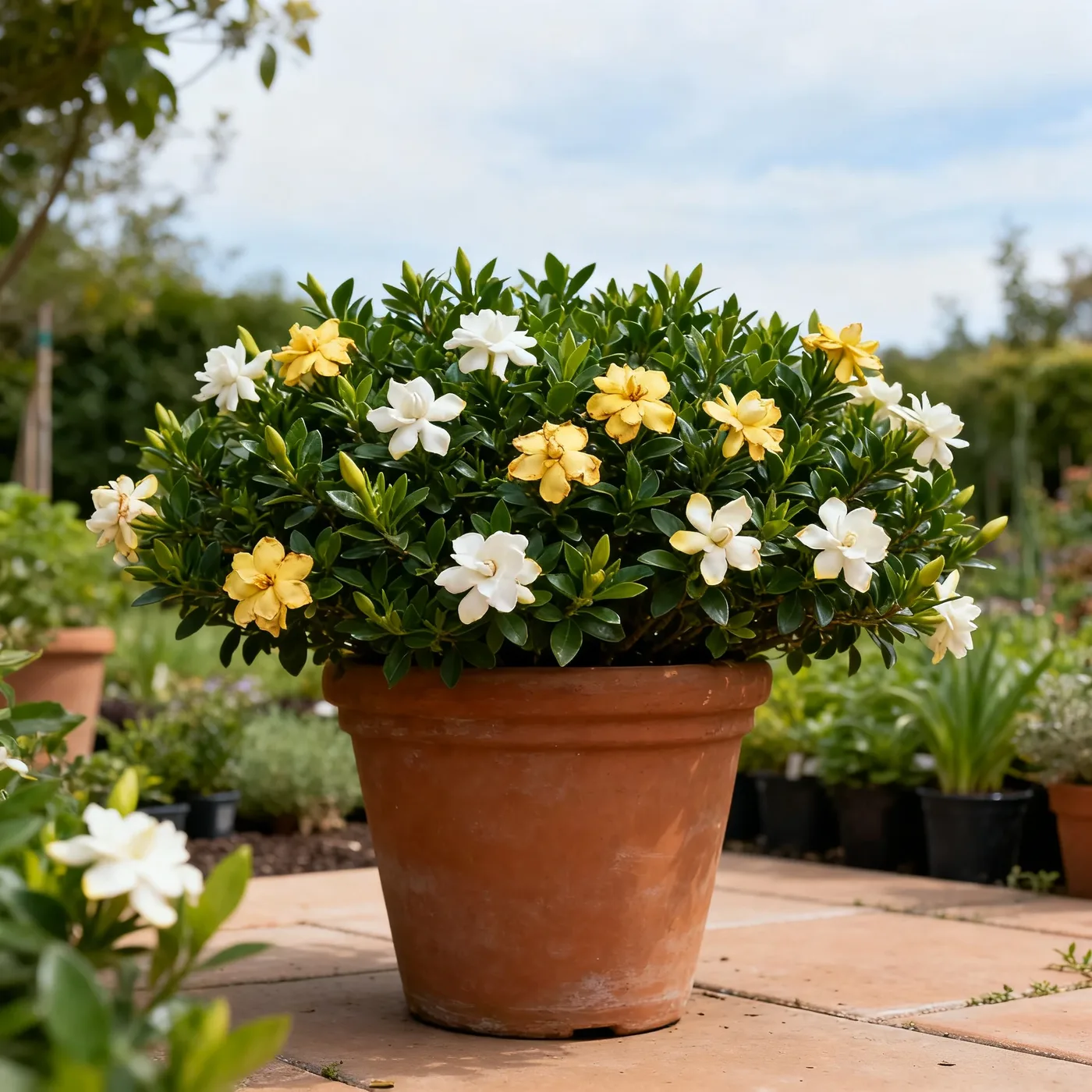
The Radicans bloom is a miniature. It bears inch-wide double flowers in summer, and NC State notes that the showy white flowers have the same heady fragrance as the parent plant but they are smaller. Double means extra rows of petals, so even at an inch across the bloom reads as a tight, ruffled rosette that sits low among the dark leaves.
Larger gardenias are a different scale, with flowers 2 to 4 inches across in single or double forms depending on the cultivar, and Virginia Tech describes velvety petals forming an open funnel up to 4 inches across. Veitchii is double like Radicans, but its flowers are bigger and carried higher, and they keep coming over a longer period.
Color Change as the Flowers Age
All three start white and age to yellow, and the species flowers are white to cream, turning yellow with age. On a small mound this shows clearly, because new white blooms sit next to older yellowing ones. Remove faded flowers after the main flush if you prefer a clean look. The older ones are not a sign of illness, only of age.
For timing across the season, our guide to Dwarf Gardenia Radicans bloom time lists when to expect the main flush and the scattered flowers that follow. The key point for comparison is that size and form change with the cultivar, while scent stays strong in all of them.
Telling Dwarf Gardenia Radicans From Its Tall Cousins
Standing in the garden center, you can sort the three in seconds. Ask how tall the plant will be, then look at the leaf and flower. The table below puts the traits side by side so you can match what you see to the plant you want.
| Trait | Radicans | Florida | Veitchii |
|---|---|---|---|
| Mature height | 6 to 18 inches | 4 feet and up | 4 to 6 feet |
| Spread | 2 to 3 feet | Wide, close to its height | 3 to 4 feet |
| Leaves | Small, dark green | Full-size, glossy | Full-size, glossy |
| Flowers | Inch-wide, double | Larger than Radicans | Double, long bloom period |
Watch the Names on the Tag
One caution comes from labeling. Florida extension notes that some nurseries and catalogs refer to 'Prostrata' as 'Radicans', so two plants sold under one name can differ a little.
Size is the safest test: if the plant is 2 feet tall and rising, it is not the low mound you want. Customers usually ask us which is best, and we tell them to pick by layer, not by name.
We would match the plant to the garden. Choose Radicans for the front, for edges and for scented ground cover in the shade. Choose Veitchii for a hedge or a corner where you want a tall, double-flowered shrub. If you are still weighing the dwarf against the full species, read Dwarf Gardenia Radicans vs Standard Gardenia Jasminoides next.
Dwarf Gardenia Radicans in Front, Tall Shrubs Behind
The three plants are not rivals. They are different layers of one planting. Radicans is the low, 6 to 18 inch mound with small leaves and inch-wide double flowers. Florida and Veitchii are the upright shrubs of 4 feet and more with larger leaves and bigger blooms. All of them want acid soil, drainage and morning sun with afternoon shade, so the choice comes down to height and where you stand when you smell them.
Picture the bed at dusk again. One low, dark green mound of Radicans sits in front of a tall Veitchii, its small white flowers just above the soil and the big ones at head height. The scent comes from both, and the garden reads as one layered planting, not two similar plants.
Dwarf Gardenia Radicans
Nursery-grown Dwarf Gardenia Radicans in sizes from 1 Gallon, shipped to your door.
From $36.97
Shop Now →Our Radicans goes into acid, freely draining ground and gets shade from the hot afternoon sun, which suits a plant that stays this low. Customers come back to us for a ground-layer gardenia that stays true to type and keeps its scent. We grow and sell top-quality shrubs as a small business with our own farms, so take a look when you are ready to plant.