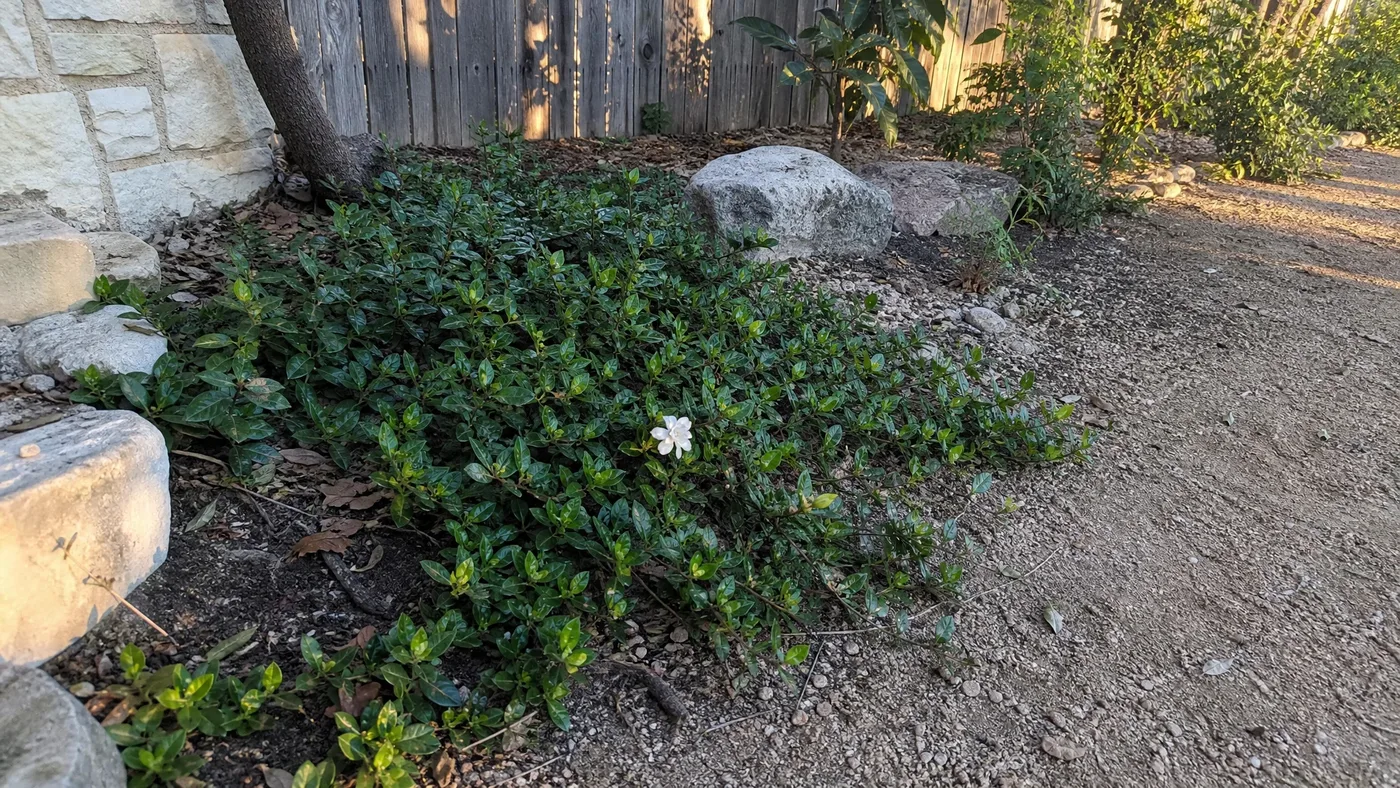
Dwarf Gardenia Radicans: Botanical Names and Origin
The tag in your hand lists a name you have never seen. Maybe it reads Gardenia augusta 'Radicans', maybe just trailing gardenia, maybe Gardenia prostrata. A small panic follows, usually in early spring when listings go up and orders get placed: is this the plant on the other nursery's page, or did you just buy something that will grow into a shrub taller than you?
The answer matters because a wrong match costs you a season. A groundcover gardenia that stays 6 to 12 inches tall is a very different purchase from a species shrub that reaches 4 to 8 feet. Read on for the plant's true origin, how its Latin name was built and rebuilt, which labels are synonyms, what each common name tends to mean, and which name differences change how you grow it.
Where Dwarf Gardenia Radicans Came From
This plant is a selected form of a shrub that grows wild in East Asia. Gardenias are native to southern China, Taiwan, Japan, and Vietnam, and the plants originated along the stream banks of southern China and Japan. Every nursery name in this guide points back to that one wild shrub.
What the Wild Habitat Tells You
A stream bank is moist but not stagnant, which fits what the plant asks of you today: steady moisture and good drainage in acid soil. Root rots are a problem primarily in poorly drained soils, and that is the same lesson in a different form. When a gardenia sulks in heavy, wet clay, the origin explains why.
Is It Native to Australia?
One of the most common questions we get is whether this gardenia is native to Australia. It is not. A plant that grows well in a warm country is not native there, and a listing that claims Australian origin tells you about the seller's copy, not about the plant.
The wild range is East Asia, and the cultivar is a dwarf selection of that Asian species. The ITIS record for the species lists only the Caribbean as introduced range, so even the formal databases do not hand you an Australian story.
How It Reached Western Gardens
Our sources do not give a date for its arrival in Western gardens, so we will not invent one. What they do show is the result: a fragrant stream-bank shrub became a standard evergreen of warm-climate landscapes, and growers then selected low, spreading forms from it. 'Radicans' is one of those forms, which is why it carries a cultivar name rather than a species name.
How a Japanese Garden Shrub Got Its Latin Name
The name you should trust is Gardenia jasminoides. ITIS gives Gardenia jasminoides J. Ellis as the accepted name, with Gardenia augusta Merr. listed as a synonym. The letters after each name are author abbreviations. They tell you that different botanists published names for what turned out to be one plant.
Why Botanists Rename Plants
When two names exist for the same species, the older valid name wins and the later one becomes a synonym. That is the whole story behind augusta. It was once used widely, it is still printed on many tags, and it is no longer the accepted name. Gardenia augusta still turns up as a former name for the species, which is a good sign that the two labels are interchangeable.
The word jasminoides means jasmine-like, a nod to the scent. Nothing about it implies a relationship to true jasmine, and the plant belongs to the coffee family.
Where 'Radicans' Enters
'Radicans' sits after the species name, in single quotes with a capital letter. That format marks a cultivar, a plant selected and propagated for specific traits, and 'Radicans' is exactly that kind of plant. The word itself is Latin for rooting, which suits a low plant whose stems creep along the ground.
So the full, current name is Gardenia jasminoides 'Radicans'. Everything else on a tag is either an older spelling or trade shorthand.
Four Labels, One Dwarf Gardenia Radicans
Four words cause nearly all the confusion: jasminoides, augusta, radicans and prostrata. Some are true synonyms and some are shortcuts. The table sorts them by how far you can rely on the match.
| Label on the tag | What it is | Same plant? |
|---|---|---|
| Gardenia jasminoides 'Radicans' | Accepted species plus cultivar | Yes, the reference label |
| Gardenia augusta 'Radicans' | Older species name, now a synonym | Yes |
| Gardenia jasminoides var. radicans or Gardenia radicans | Variety style or shortened trade writing | Usually, confirm the size |
| Gardenia jasminoides 'Prostrata' or Gardenia prostrata | A separate trailing name | Sometimes sold as Radicans |
The last row needs care. A University of Florida publication on 'Prostrata' states that some nurseries and catalogs refer to 'Prostrata' as 'Radicans'. We found no accepted species called Gardenia radicans or Gardenia prostrata in our sources, so read those two as trade shorthand for a dwarf cultivar, not as separate species.
The Variety Label
The 'var. radicans' style belongs to an older way of writing a botanical variety. A variety is a natural variant ranked below the species, while a cultivar is a plant selected in cultivation. Current references treat 'Radicans' as a cultivar. If you meet the older style, it still points at the same low plant, so check the listed size and move on.
The practical split is simple. Augusta is a pure synonym. Prostrata may or may not be the same plant, and hardiness is where the difference shows.
Cape Jasmine and Other Common Names
'Radicans' goes by five common names: cape jasmine, creeping, dwarf, miniature and trailing gardenia. They fall into two kinds. One describes the whole species, and four describe the plant's habit or size. Knowing which kind you are reading tells you what the seller is promising.
Cape jasmine belongs to the whole species. On its own it says nothing about size, and a listing that uses only this name may be selling a shrub that grows several feet tall. Look for a cultivar word beside it.
Creeping and trailing describe the spreading habit. They fit this plant, which spreads 2 to 3 feet, and they are also the words most often attached to the Prostrata label.
Dwarf and miniature describe size. Miniature can also fit the blooms, since the double white flowers are 1 to 2 inches wide, with the same heady fragrance as the parent plant but smaller. Dwarf is the loosest of the five, because other cultivars use it too, as our guide to dwarf gardenias and how Radicans compares shows.
A listing that combines two of these words, such as creeping dwarf gardenia, is usually describing habit and size together. That is a good sign, but still ask for the cultivar word.
If the Tag Says Prostrata, Do This
Most buyers hit one odd label and stall. Work through the case that matches yours, and you will usually have an answer in under a minute.
- The tag says Prostrata. Ask for the mature size and the hardiness zone. The Florida publication gives zones 8 through 10 for 'Prostrata', while NC State lists 'Radicans' at 7b through 8b. If you garden near the cold edge, check our zone guide before you buy.
- The tag says augusta. Treat it as Radicans if the cultivar word follows. The genus spelling does not change the plant.
- The tag says only Gardenia jasminoides or cape jasmine. Assume the species shrub. It is not the groundcover, and it will outgrow the spot you picked. Our comparison of Radicans and standard jasminoides shows how far apart they grow.
- The tag says var. radicans or Gardenia radicans. Accept it when the listed spread is 2 to 3 feet and the habit is low. If the seller gives no size, ask.
- The tag says only dwarf gardenia. Ask which cultivar. Several dwarf forms exist, and the word dwarf alone does not identify one.
- The listing says native to Australia. Ignore that line and judge the plant on the cultivar name and the habit.
When the seller cannot answer a basic question about height, say so and move on. A seller who knows the plant can answer it in one sentence.
Does the Name Change How You Grow Dwarf Gardenia Radicans?
Mostly no. A name tells you which plant you have, and the plant's needs stay the same whatever the tag says. A few differences do change your plan, though, so it helps to separate them.
Names That Are Only Paperwork
Jasminoides versus augusta changes nothing. The same plant needs the same soil, and the rule that matters most is acid soil. Clemson says gardenias prefer acid soils with a pH of less than 6.0, moist and well drained, in light to partial shade with morning sun and afternoon shade.
If leaves yellow, test pH before anything else, whatever the label said. Our soil and pH guide walks through the fix. Pests follow the species as well. Whitefly is the most common problem, and the Florida publication lists white fly, scale and aphids for the trailing form. Sooty mold on the leaves is a sign of whitefly honeydew.
Names That Change Your Plan
The cultivar word does matter, and size is the biggest gap. Clemson puts 'Radicans' at only 6 to 12 inches tall with a 2 to 3 foot spread, against the species at 4 to 8 feet. That affects spacing, pruning and what the plant can sit beside. Flowers differ too: the species carries 2 to 3 inch blooms, and the cultivar's are smaller.
Hardiness is the second gap. The species is hardy in zones 7b through 11b and the cultivar only in 7b through 8b, so 'Radicans' is not very cold hardy. Gardeners at the cold edge should read our winter care guide, because advice written for a tall species shrub will not protect a low plant the same way.
The rule of thumb: if the question is about soil, light, water or pests, any name will do. If it is about size or cold, make sure you know the cultivar.
Reading Any Dwarf Gardenia Radicans Label With Confidence
The routine is short, and it works on any listing. First, find the cultivar word. 'Radicans' in single quotes after the genus and species tells you the plant. Second, ignore the genus spelling, because jasminoides and augusta point at the same shrub. Third, buy on the plant's habit, not its label: a low, spreading plant of 2 to 3 feet is what you want, whatever name the seller prefers.
Treat Prostrata as a prompt to ask about hardiness, and treat any claim of Australian origin as a sign to read the listing more closely. The plant is from East Asia, and its needs stay consistent across every name.
Dwarf Gardenia Radicans
Nursery-grown Dwarf Gardenia Radicans in sizes from 1 Gallon, shipped to your door.
From $36.97
Shop Now →Dwarf Gardenia Radicans does best in damp, acidic ground that drains well, so that is the bed we give it on our farms, with sun in the morning and shade through the hot afternoon. Because we are a small business run by the people who grow the plants, nothing leaves here unless we would put it in our own garden. Whenever you are set to plant the right 'Radicans', we would love for you to see which ones are ready.