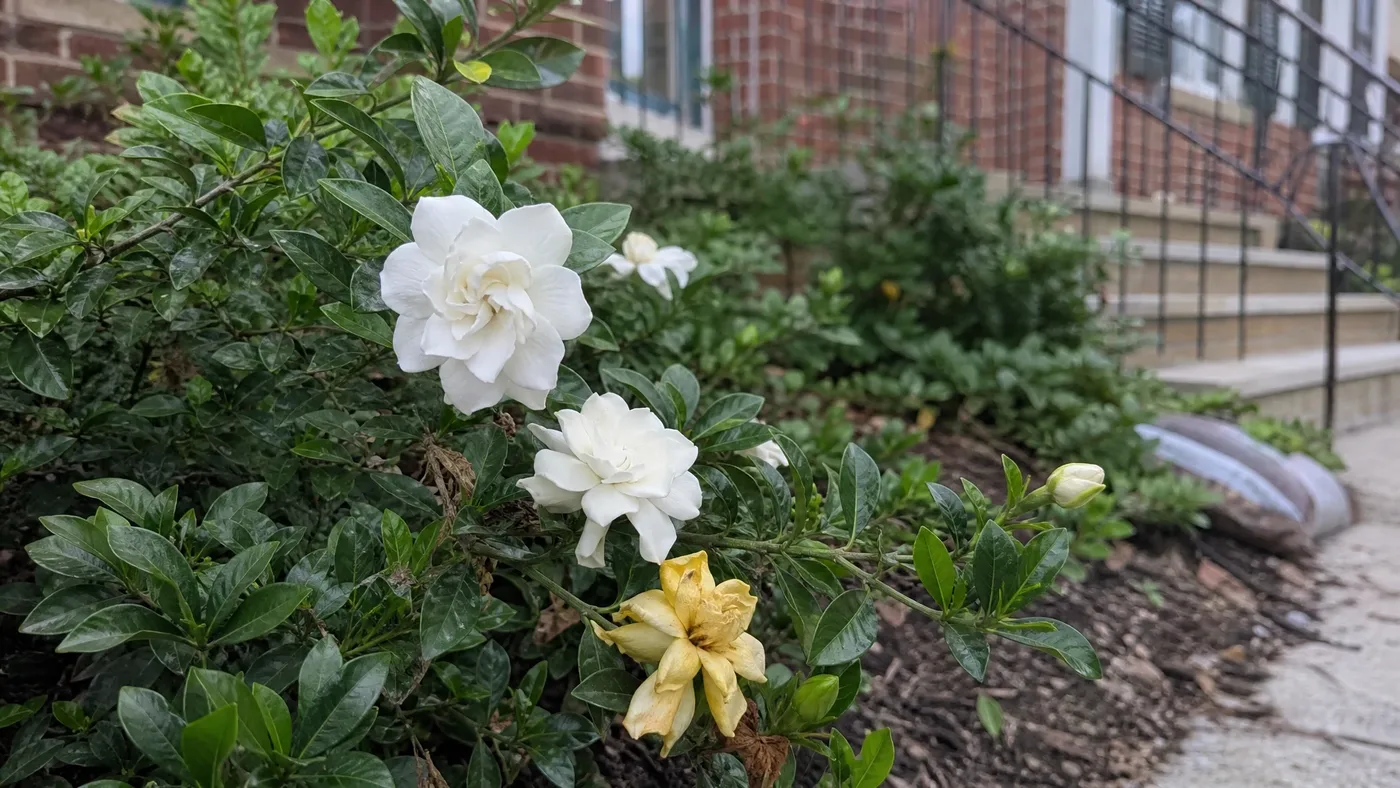
Dwarf Gardenia Radicans Flowers: Size, Shape and Color
If you have been wondering whether your flowers look smaller than the photos, the reassuring answer is yes, that is normal. It is the question we hear most from new owners, and it usually comes with a worry that the plant is underfed or in the wrong spot. Most of the time the plant is fine. It is simply a dwarf cultivar with a dwarf flower, and knowing the normal size spares you from "fixing" something that is not broken.
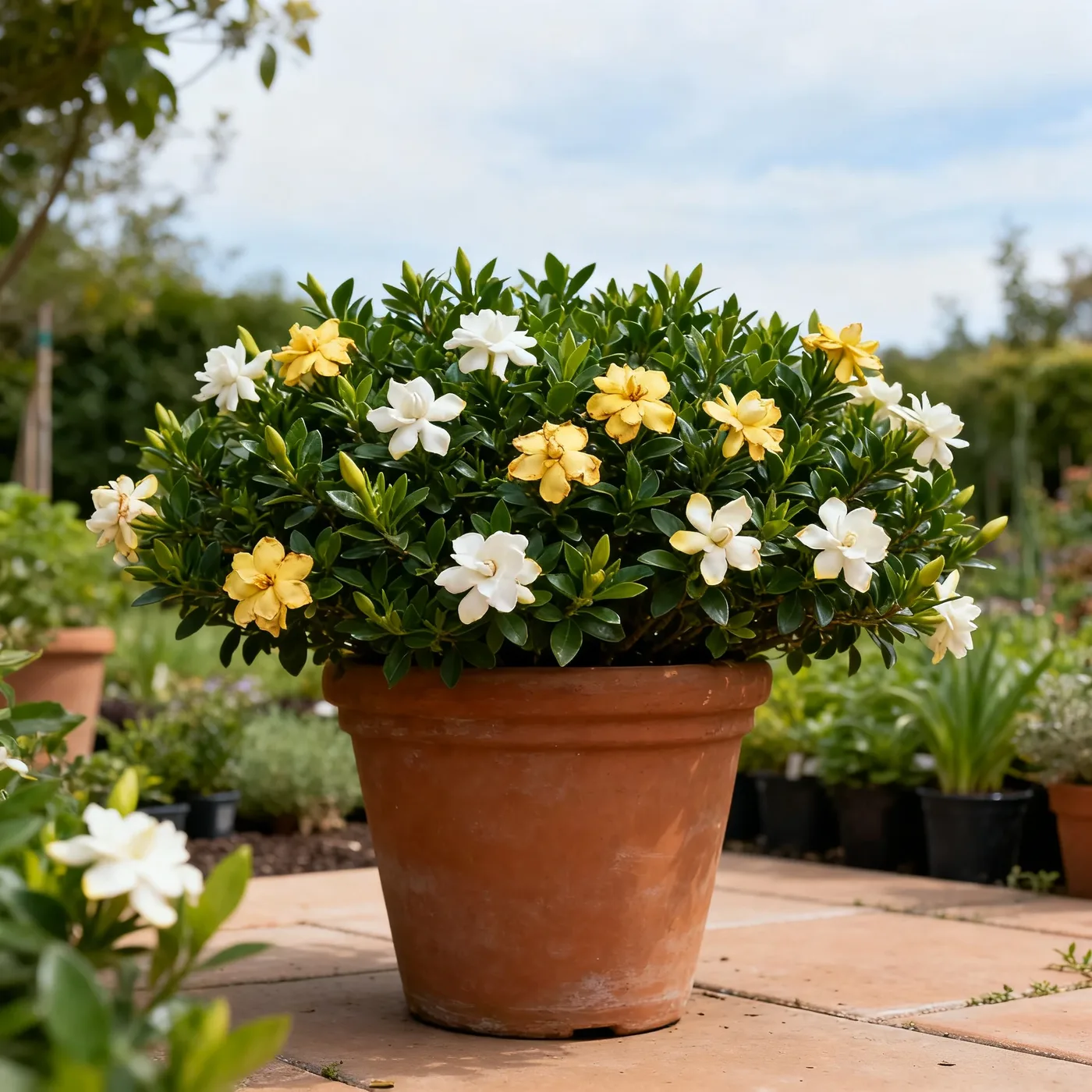
Below, you'll find out all about the bloom itself, including how to measure one properly, how many petals to expect, how the flowers sit on the branch, why the color moves from bud to white to cream, and how to read what you see.
Dwarf Gardenia Radicans Flowers Are Smaller Than You Expect
The flowers on this cultivar are fragrant, white to cream, double and waxy, 1 to 2 inches wide. They open as inch-wide double flowers in summer. Compare that with the standard gardenia shrub, which bears 2 to 3 inch waxy flowers and, depending on the cultivar, can run 2 to 4 inches across. Your bloom is not underperforming. It was never meant to be that big.
The gap is easiest to see against a named standard. 'August Beauty' has double flowers about 3 inches across on a shrub 4 to 6 feet tall. Radicans stays 6 to 12 inches tall and spreads 2 to 3 feet, so a small flower on a low mat is the right proportion for the plant. Our full side-by-side is in Dwarf Gardenia Radicans vs Standard Gardenia Jasminoides.
Small does not mean weak. The white flowers have the same heady fragrance as the parent plant, only in a smaller package, and we cover what to expect from the scent in our fragrance guide. If your blooms are in the 1 to 2 inch range, you are looking at a normal plant.
Measuring a Bloom With a Ruler and a Hand Lens
Photos fool the eye, so measure once and stop guessing. You need three cheap things: a small ruler marked in inches, a hand lens (a 10x loupe is plenty), and a notebook that stays near the plant. The ruler gives you diameter, the lens settles petal counts that the naked eye muddles, and the notebook lets you compare this year against next.
Pick a flower that is fully open but still fresh, because a bloom that has started to age may be drooping and reading smaller or larger than it was. Work the same way every time:
- Hold the ruler flat behind the flower, without pressing the petals, and read across the widest point from one petal tip to the opposite tip.
- Turn the ruler a quarter turn and measure again, since flowers are rarely perfectly round. Write down both numbers.
- Use the hand lens to look straight into the center and count the petals from the outside in, ticking each off as you go.
- Record the date, the time of day, the stage of the bloom and where it sits on the plant.
Measure three or four flowers rather than one. A single odd bloom tells you very little, but an average across a handful tells you what your plant normally makes.
Single, Semi-Double and the Petals Between
Petal arrangement runs along a scale. A single flower shows one ring of petals with the center open. A semi-double adds extra petals that fill part of the center. A double packs enough petals that the center is hidden. Clemson says gardenia flowers, depending on cultivar, can be either single or double, and the University of Arkansas extension lists cultivars from semi-double to double, with Radicans placed among the doubles.
You may still see Radicans described as single to semi-double on a tag or in a listing. We would not argue with your own eyes here. Extension sources call it double, and the flowers are small enough that a loosely filled one can look more open than the word suggests. Your notebook count is the best answer for your plant.
Why Counts Vary on One Plant
Do not be alarmed if two flowers on the same plant give different counts. A bloom you catch early may have petals still folded into the center, and one past its best may have lost an outer petal. Position matters too, since a flower at the end of a shoot often opens more fully than one tucked among leaves. Count several, note the stage, and treat the middle of your range as your plant's normal.
How Dwarf Gardenia Radicans Carries Blooms on the Branch
Because the plant hugs the ground at 6 to 12 inches tall, the flowers do not hang on tall stems the way they do on a big gardenia shrub. They sit on short shoots among the glossy leaves, held just above the foliage mat. A good way to study this is to crouch beside the plant and look across the top of it rather than down into it, where the leaves hide where each stem begins.
In our rows, we usually see blooms singly or in twos and threes near the shoot tips, with more along the branch as the plant fills out. The flowers open over a long stretch, from May through June and sporadically through summer, so one plant often carries buds, fresh blooms and aging ones together. Our bloom time guide explains that rhythm.
Spotting Blooms From a Few Feet Away
From three or four feet back, you will not see individual petals. You will see pale dots scattered over a dark green carpet. The Arkansas extension calls this a polka dot effect of white and soft yellow at peak flowering, which is a fair description of the species and a useful picture to hold in mind. If those dots appear mostly at the ends of the stems, the plant is flowering normally.
Light and Temperature That Shift the Color
Age is the one color change we can point to with confidence, and the sources are consistent on it. Light and temperature are harder. There is no sourced figure for how much sun or how cool a night changes the shade of a Radicans bloom, so we will not hand you one. Instead, compare blooms of the same age on the same plant, one from a brighter spot and one from a shadier spot, and write down what you see.
Light still matters for the plant as a whole. Gardenias do best in light to partial shade, preferably morning sun and afternoon shade, and a plant stressed by hard afternoon sun is more likely to look off in every way, flowers included. Our sun requirements guide covers how much light is right.
Cold is a separate matter. Radicans is not very cold hardy, and it is not frost tolerant either. A flower that turns brown and limp after a cold snap is damaged, not aging. A flower that slowly shifts from white to cream over its life is doing exactly what it should.
From Purple-Tinged Bud to Creamy White Dwarf Gardenia Radicans Flower
A Radicans bloom changes color over its life, and each stage looks a little different. The sources describe the flower as white to cream that ages to yellow, and the Arkansas extension says the white fades to a distinctive medium yellow as the flowers age. The table lays out the sequence from bud to old flower, with what is normal at each step.
| Stage | What you see | Is it normal? |
|---|---|---|
| Tight bud | Closed, tightly wrapped, sometimes with a faint tinge | Yes, as long as it keeps swelling toward opening |
| Fresh open flower | Waxy white, sometimes creamy at the center | Yes, this is the stage to measure |
| Middle age | White easing toward cream | Yes, this is ordinary aging |
| Late bloom | Yellow, soft petals | Yes, it is ready to be removed |
The one stage we would watch is the bud. A faint tinge on a bud is not something we treat as a problem. What matters is whether it swells and opens. A bud that yellows, shrivels and drops before opening points to a watering or stress issue, and our problems guide walks through it.
Dwarf Gardenia Radicans Photos, Labels and What You Will Really See
Nursery photos are usually close-ups with the flower filling the frame, which makes a 1 to 2 inch bloom look as big as a hand. A tag photo may also show the very best flower on the best day. Do not measure your plant against the picture. Measure it against the written range and your own notebook.
Names add confusion. The University of Florida notes that some nurseries and catalogs refer to 'Prostrata' as 'Radicans', so two labels can describe plants that look alike but are not described identically in every source. If a tag gives a bloom size outside the 1 to 2 inch range, check the botanical name against what you bought.
Using a Phone Camera Fairly
Put a coin or the ruler in the frame beside the flower, and shoot from the same distance each time. Take the photo in open shade or on an overcast day, because bright sun blows out the white and hides the cream. Skip filters. Photograph a fresh flower, a middle-aged one and an old one on the same day, so the progression is on record and you can see the color difference side by side.
What Your Dwarf Gardenia Radicans Blooms Are Telling You
Healthy blooms are easy to describe. They are firm, waxy and white to cream, in the 1 to 2 inch range, and they open fully on a plant with glossy, deep green leaves. Yellow petals on an old flower are normal. A common worry is whether yellow flowers mean something is wrong, and the answer is no unless the leaves are yellow too.
Leaves are where the real warnings show up. Yellowing leaves between green veins usually point to soil that is not acidic enough. Clemson says gardenias prefer acid soil with a pH of less than 6.0, moist and well drained, and our not blooming or yellowing guide goes through the fixes. Root rot is a worry mainly in poorly drained soil, so check drainage before you reach for fertilizer.
Also check for sticky leaves and a black film. Whitefly is the most commonly occurring problem on gardenias, and the sooty mold that follows can dull the whole plant. Treat the pest first, then wipe or let the film weather away. Blooms that are the right size, stay on the plant and age to cream on schedule tell you the plant is happy.
A Small Flower Worth Keeping Track Of
A Radicans bloom is small by design, about 1 to 2 inches across, double or close to it, and white that ages to cream and then yellow. Smaller than the photos is normal. Smaller than last year, with leaf yellowing or bud drop alongside, is the time to look at soil, light and drainage.
This week, photograph one open bloom beside a coin and write the date and your measurement in your notebook. Keep that picture as your baseline, and next year you will have something real to compare against.
Dwarf Gardenia Radicans
Nursery-grown Dwarf Gardenia Radicans in sizes from 1 Gallon, shipped to your door.
From $36.97
Shop Now →Dwarf Gardenia Radicans grows best for us in light to partial shade, in acidic soil that drains well, and that setting is what lets it carry the small, waxy white blooms this guide covers. Every plant comes from a small team of growers working on our own farms, and we put only top-quality plants in front of you. Once you know what a healthy Radicans flower should look like, we would love for you to pick out a plant for your own garden.